


AIoT Boosts Agentic AI
For logistics, manufacturing, healthcare, OEM, and other industrial types of applications, AI is most powerful when paired with Internet of Things (IoT) devices. Sensors measure all sorts of conditions and either continuously or periodically report data to a centralized system, such as a database, application, or dashboard. Sensors have been around for a long time and have contributed to advances in preventive maintenance, workflow optimization, and other common functions. Until recently, sensor data has been used to mark state data: how a given machine or process is doing at this moment in time. This AIoT environment has really begun to boost operational excellence through the combined use of AI, IoT and agentic AI. Let’s take a look at how this is being done.
Until recently the ability to make effective decisions based on sensor data has required a lot of time and many analysts. Employees poring over spreadsheets and reports, making connections and educated assumptions.
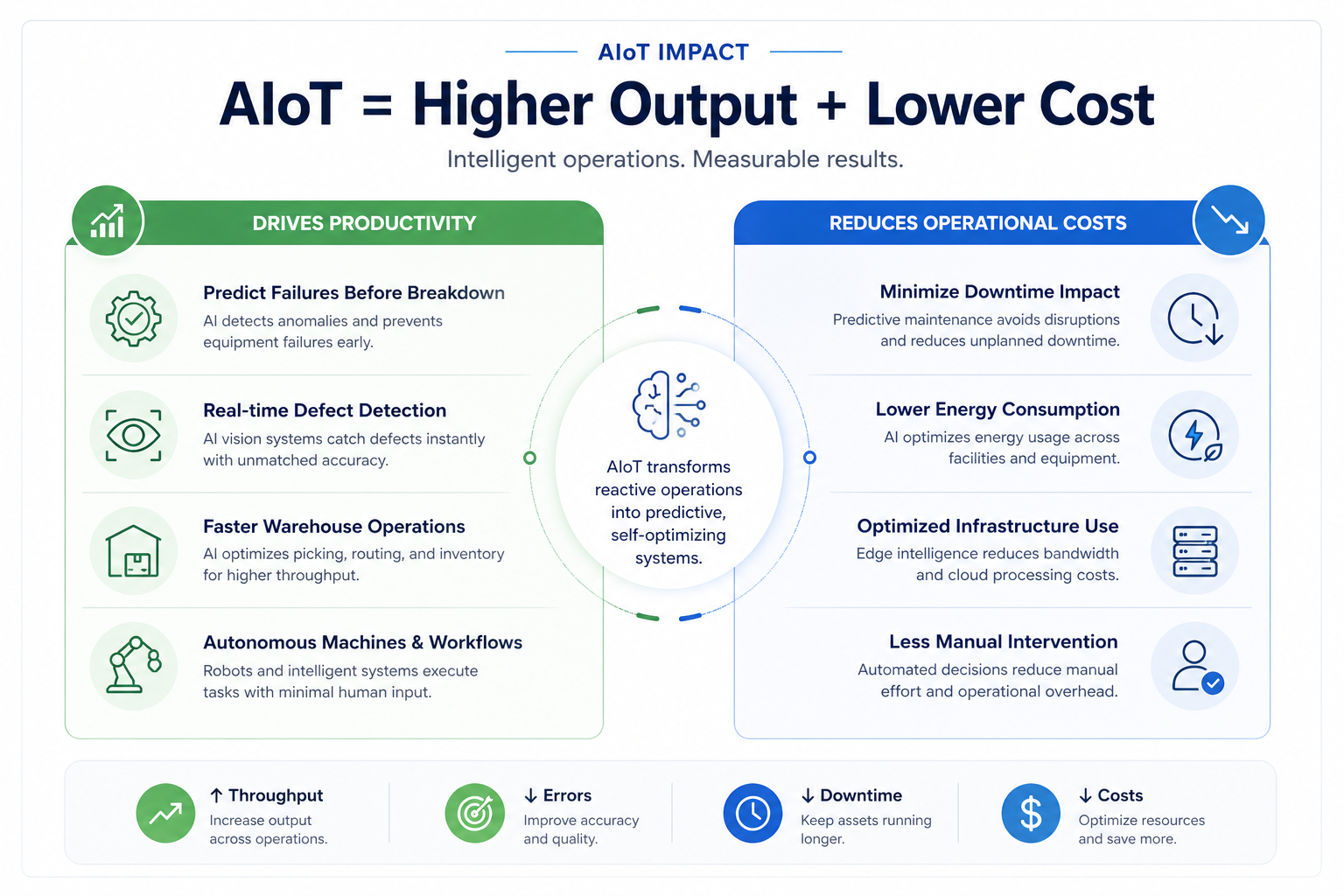
Today, what we call AIoT (Artificial Intelligence of Things), can do the same thing in a fraction of the time. AIoT enhances manufacturing productivity and reduces costs by transitioning operations from a reactive, human-dependent model to a predictive, autonomous, and self-optimizing system. By the end of 2025, over 61% of industrial organizations were actively experimenting and deploying AI at scale to achieve these outcomes.
AIoT Drives Productivity
By increasing throughput, reducing errors, and accelerating decision-making through several key applications, such as:
- Predictive Maintenance: This is the most common AIoT application, utilized by nearly 71% of organizations. Sensors measure vibration and temperature and can detect potential equipment failures up to 72 hours before they occur. Preventive maintenance was a step up from fully-reactive maintenance, but it was calendar-based. Predictive maintenance lets you or an AI agent schedule maintenance during a planned window rather than dealing with an emergency situation.
- Automated Quality Inspection: Today, AI-powered machine vision systems identify microscopic defects or deviations in real-time with speed and accuracy far surpassing human capabilities. This active approach decreases scrap ratios and ensures consistent product quality in all types of industries, including OEM, parts manufacturing, food production, and more.
- Warehouse and Logistics Optimization: Logistics operations have found that semi-automated systems using AI-assisted picking and real-time path recommendations produce measurable gains, including a 40% improvement in picking speed and a 69% reduction in error rates. And that doesn’t include an improvement in safety.
- Autonomous Operations: We are just beginning to see more use of autonomous-guided vehicles and collaborative robots in controlled industrial settings. The convergence of 5G and AI enables the use of these tools that can navigate complex factory environments safely and efficiently.
AIoT Reduces Operational Costs
The economic benefits of AIoT are significant, with 54% of industrial executives expecting major cost savings from initiatives like:
- Minimizing Downtime: By shifting from reactive to predictive maintenance, manufacturers can extend asset lifespans. By eliminating unplanned shutdowns, companies can avoid large, recurring costs.
- Energy Efficiency: While AI has driven up overall energy costs during its R&D phase, individual companies have so far found that AI-driven systems can be used to monitor consumption patterns and can dynamically adjust HVAC, lighting, and cooling cycles, potentially reducing energy use by 15% to 30% on a company by company basis.
- Infrastructure and Data Savings: Edge computing processes data close to the source, rather than sending it to a far-off server, then sending results back. Edge computing lowers latency for mission-critical tasks and reduces bandwidth costs associated with sending large volumes of raw sensor data to the cloud.

Strategic Implementation of AIoT and Its ROI
To realize these gains, you must treat AI as a core operational capability rather than an experimental project. Yes, implementation costs increase as technology matures. But, the projected benefits, represented by market value, are growing exponentially, indicating a strong return on investment for early adopters. However, the skills gap is a major barrier; nearly 38% of manufacturers cite a lack of skilled talent as a primary obstacle to successful AIoT adoption.
The Internet of Things (IoT) has transitioned from simple data collection to a foundational infrastructure for intelligent, autonomous business operations. While many early IoT installations focused on basic telemetry and simple rule-based logic, the current era is defined by the convergence of AI and IoT. This convergence is often referred to as Artificial Intelligence of Things (AIoT).
The Trajectory of IoT and Business
- From Connectivity to Infrastructure: In recent years, IoT has transitioned from a technology “big on promise but short on specifics” to a critical digital infrastructure. By 2024, there were 18.5 billion connected devices, a figure that grew to over 21 billion by the end of 2025.
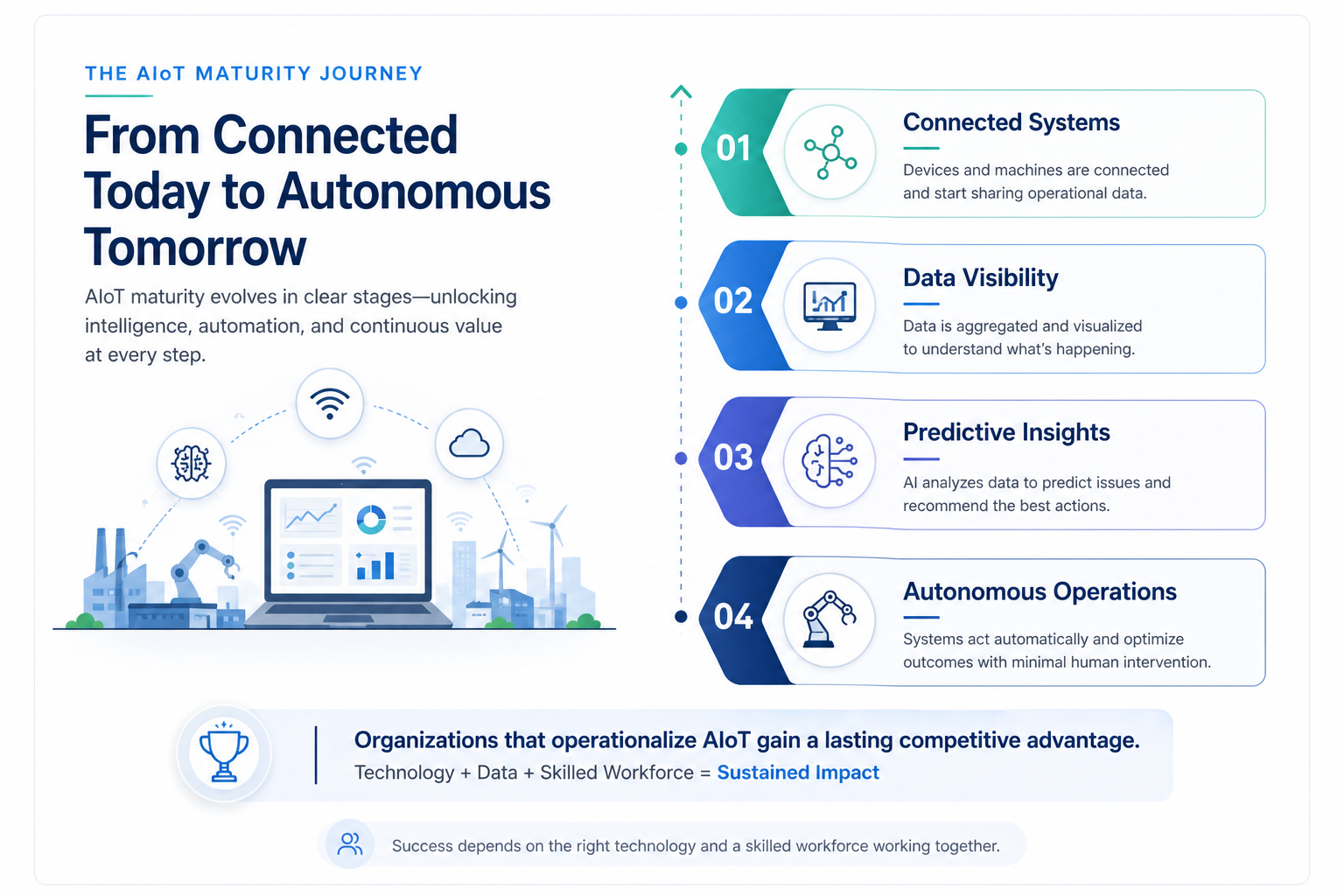
- The Shift from Pilots to Production: While 2025 was a year of experimentation and pilots, 2026 is becoming the year when many organizations moved to production-ready AI projects. Businesses are no longer just looking at dashboards; they are developing autonomous systems that can sense, decide, and act with minimal human intervention.
- Maturity of Hardware: Historically, IoT endpoints have lacked the built-in compute power required for AI workloads. Instead, these endpoints relied on external processing. That gap is closing as vendors integrate Neural Processing Units (NPUs) and low-power AI accelerators into broad device categories, enabling local inference, thereby distributing compute costs across the network of IoT devices..
How IoT and AI Work Together Now
The relationship between the two technologies is often described with the metaphor that IoT/5G provides the “pipes” or “nervous system,” while AI provides the “brains.”
- Real-Time Intelligence at the Edge: AIoT deploys machine learning models directly on devices or gateways, allowing for instant data analysis and trigger actions. This edge computing approach reduces latency, strengthens resilience, and lowers the cost of sending massive data volumes to the cloud.
- Predictive vs. Reactive Operations: AI enables IoT systems to move past reporting and reacting to predicting and adapting instead. For instance, sensors on critical machinery can detect potential failures up to 72 hours before they occur, allowing for scheduled maintenance that avoids costly unplanned downtime.
- Autonomous Workflows: Autonomous workflows are now a thing. The adoption of autonomous mobile robots (AMRs) and automated guided vehicles (AGVs) in logistics is a game-changer. In these new environments, AI interprets sensor data to navigate complex environments safely.
- Enhanced Cybersecurity: AI has become an essential asset for securing IoT networks. In the past, IoT devices employed widely varied levels of security. But today, AI-powered anomaly detection can monitor massive volumes of machine data to identify cyberattack patterns faster.
AIoT Business Impact and Future Outlook
As the technology matures, 61% of industrial organizations are now actively deploying AI at scale. The primary drivers for this adoption include improved productivity (63%) and cost reduction (42%). Businesses that fail to integrate intelligence into their IoT strategies are expected to fall behind, as the “competitive edge” increasingly belongs to those who can turn raw data into autonomous decisions.
The urgency of the skills gap challenge has grown, climbing from the fifth-most significant barrier in 2019 to the top challenge by 2025.
Direct Impacts on AIoT Deployment
- Constrained Scalability: While many organizations are confident in their ability to pilot AI, deployment remains constrained by a lack of workforce readiness, preventing projects from moving to a production-ready or enterprise-wide scale. Infrastructure reliability compounds this challenge: 96% of manufacturing decision-makers say wireless connectivity is critical to AI success, yet 56% report that unreliable wireless connectivity frequently disrupts manufacturing operations ( Cisco 2026 State of Industrial AI Report ).
- Delayed Timelines: Organizations lacking a collaborative, skilled workforce report slower deployment timelines and fragmented ownership of AIoT projects.
- Cybersecurity Vulnerabilities: A persistent shortage of expertise in both AI and cybersecurity hinders the ability of manufacturers to design and monitor resilient systems, leaving them exposed to sophisticated AI-driven threats.
- Underutilization of Data: Without staff proficient in data science and analytics, manufacturers struggle to turn the massive volumes of raw sensor data into actionable insights, leading to a “trust deficit” in AI outcomes.
Critical Skill Set Requirements
Successful AIoT deployment requires a workforce capable of bridging the gap between Information Technology (IT) and Operational Technology (OT). Manufacturers have identified several essential skill sets for scaling these technologies:
- AI/ML model development (46%).
- OT domain expertise (38%).
- Data science and analytics (36%).
- Industrial networking and security (34%).
- Cloud and edge architecture (28%).
Strategic Solutions and Workforce Enablement
Mature adopters of AIoT insist on the need for closer alignment between technology investment and workforce capability. To mitigate the skills gap, experts recommend treating workforce enablement as a core operational strategy rather than an isolated training program. That means ongoing investment in training and certification.
Some proposed solutions include upskilling existing teams through specialized credential programs and fostering cross-disciplinary collaboration between IT and OT staff. e South Korea, for example, has addressed this issue by establishing a government-led initiative that provides manufacturing mentors to upskill the existing workforce in automation and AI. Small and medium-sized manufacturers (SMMs) are particularly vulnerable to these barriers. They may require greater assistance from industry associations and academic institutions to build internal AI literacy. Some large manufacturers may see the skills gap as a potential moat that is beneficial to them. This is short-term thinking. Big companies should be investing in industry associations and academic institutions that can educate the next generation of employees.

Frequently Asked Questions (FAQ)
1. What is AIoT, and how does it differ from traditional IoT?
Traditional IoT connects devices and collects data. AIoT adds a layer of machine learning that interprets that data continuously. They enable systems to predict outcomes and trigger autonomous responses rather than just reporting what happened.
2. What does “predictive maintenance” actually look like in practice?
Sensors on critical equipment monitor performance signatures in real time. That lead time lets maintenance teams schedule a planned intervention instead of responding to an emergency breakdown.
3. How long does it typically take to see ROI from an AIoT deployment?
Early efficiency gains from route optimization and predictive maintenance scheduling are often measurable within the first 90 days. Full ROI across an enterprise deployment typically follows over a 6-18 month window as models improve with more operational data.
4. What are the biggest barriers to AIoT adoption in manufacturing?
The most common obstacles are workforce readiness gaps and infrastructure reliability. Organizations that address both through structured training programs and connectivity assessments see significantly faster deployment timelines.
5. How do we secure an AIoT environment against cyber threats?
Security needs to be designed into the architecture from the start, not added after deployment. Best practices include encrypted telemetry, role-based access controls, and defined boundaries around autonomous actions.
6. Do we need to replace our existing systems to deploy AIoT?
In most cases, no. AIoT platforms integrate with legacy SCADA historians, CMMS platforms, and ERP systems. You can connect to data through ETL pipelines or API connections. The goal is to build an intelligence layer above what already exists.
About Bridgera
Operational Intelligence. Production-Ready AI.
Bridgera partners with operations-heavy enterprises to move AI beyond pilots and into real production systems. Through AI consulting, specialized talent, and scalable platforms like Interscope AI™, Bridgera embeds intelligence directly into the operational workflows that power the business.