


Solving This One Problem Will Increase Your ROI
Ghost alarms are killing your profitability. Unnecessary truck rolls and service calls can cost you thousands of dollars a month, depending on how many customers you have and how many trucks and technicians. Of course, the winter overpressure phenomenon is the main culprit in the cold months. We understand the root causes well:
- VOC limits are suspended between November 1st and March 31st, raising RVP significantly. As you probably know, VOCs contribute to ground-level ozone, but mainly during warm and sunny periods of weather. Therefore, restrictions are often relaxed in cold months due to lower ozone-producing emissions.
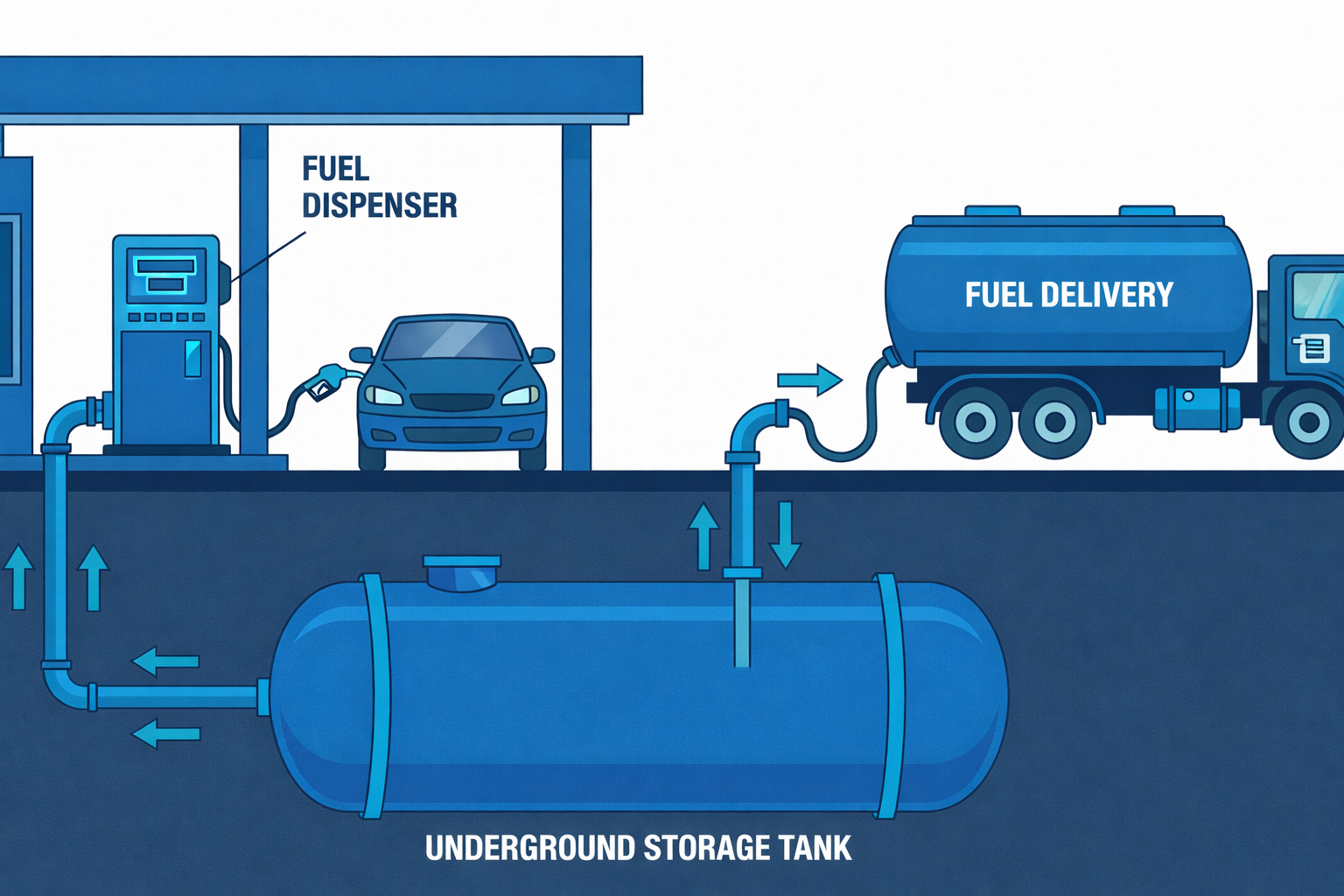
- The resulting higher volatility, due to the addition of butane to fuel stocks, increases vapor pressure inside the recovery system, triggering overpressure thresholds even without a hardware fault.
- ~30% of post-2003 vehicles ingest excess air through nozzle fit gaps. This can force air into storage tanks, increasing tank pressure. The tanks then typically attempt to vent some of the air to decrease the pressure. However, venting can release gas vapor, which is not only an environmental problem, but over time it results in loss of sellable product.
- Flow rates below 6.0 gallons per minute compound air ingestion at the nozzle. Slow flow rates can increase air ingestion, causing the excess air pressure problem mentioned earlier.
- ISD systems cannot distinguish chemistry-driven pressure spikes from real breaches. This is where operational AI can make a huge difference. By building risk profiles based on historical service data, the AI can recognize when there is most likely a leak rather than a false alarm due to over-pressurization.
The Cost of a Truck Roll
The fully loaded cost of a dispatch (labor, fuel, insurance, opportunity cost) adds up to a large expense over time.
- Technician drive time alone can consume two to four billable hours. At an average billable rate of $145, a ghost alarm can cost anywhere from $300 to $600.
- Systems are built to support regulatory requirements. Therefore, ghost alarms require mandatory authorized service dispatch, regardless of the likely cause. After the second consecutive alarm on the same system, entire facilities may be shut down until the problem is resolved.
- Your insurance and liability exposure begins the minute the truck leaves the yard. If that truck roll turns out to be for a false alarm, and your driver has an accident on the way back to the yard, it makes that call especially costly.
- Repeat false-alarms degrade customer trust and contract renewal probability.
How to Fix the Problem
You need to optimize V/L ratios to the 0.95–1.0 range so they don’t trigger the ghost alarms. You should install EOR spout assemblies if you haven’t already done so.
- With an AI-driven solution, your V/L ratio is more easily tunable within the certified 0.95–1.15 range. By keeping the ratio steady toward the lower end you can reduce excess air ingestion. If you have trouble maintaining the level on a particular device, it will become obvious where the problem lies, much more quickly than before.
- Operational AI systems can recommend seasonal V/L adjustments on a per dispenser basis, rather than having to apply a blanket ratio to the entire site.
- EOR retrofits are field-installable on existing nozzle bodies without replacing the entire nozzle body. Thus, you and your customers save on parts and maintenance.
- Operational AI can target the most frequent-alarm dispensers first. This gives you a chance to fix or replace the troublesome devices first, maximizing your ROI on your retrofit program.

Operational AI Is a Labor Multiplier
Bridgera’s experience solving the problem of ghost alarms can help you save a lot of money, quickly. Filtering 75% of nuisance alarms is like hiring new technicians by recapturing lost capacity.
- By deploying AI-driven remote confidence scoring based on historical data from your actual experiences, your system can start routing only credible alarms to dispatch queues.
- Our data-fusion approach cross-references RVP, V/L history, and P/V valve test (TP-201.1E) records for the highest confidence level possible. We have experience with all types of sensors and sensor data, as well as a solid understanding of the technical and business issues you are facing.
- Scanning historical failure reports is a way to “fingerprint” and distinguish chemistry-driven spikes from genuine breaches. As our solutions gather more data, they become even smarter about nuances in different root causes.
- You can easily deploy recaptured hours toward scheduled PMs and revenue-generating work, putting your customers on a more regular and sustainable maintenance path.
- Your technicians will experience higher satisfaction because their dispatches are purposeful, not frustrating.
Bridgera’s Experience
Refer to the blog posts on the Bridgera.com website. They describe parts of the underlying AI models that distinguish between environmental volatility and a mechanical breach. The Bridgera operational AI solutions are a synthesis of a number of techniques, rooted in a deep understanding of operations across industrial applications:
- Seasonal RVP data is ingested alongside historical transaction logs to provide context to every alarm event. The operational AI learns patterns it finds in the data, from perfect operation to complete failure and everything in between.
- The AI assigns granular confidence levels, not binary pass/fail determinations, to each condition it identifies.
- Bridgera’s IIoT experience combined with operational AI expertise provides you with the benefit of Bridgera’s experience with industrial operations and modern technology. Bridgera understands your business and tailors its AI solutions to provide specific insights and actions that are geared to the operational systems you use.
Frequently Asked Questions (FAQ)
1. Why does every ISD alarm require a mandatory authorized service dispatch?
State and Federal) environmental regulations treat ISD systems monitoring infrastructure, not advisory tools. When an alarm signals an overpressure alert, the ISD is legally required to log the event and initiate a response chain, regardless of the suspected cause. Two consecutive alarms on the same system often trigger an automatic shutdown of the entire facility. This shutdown remains in effect until the resolution is certified by an authorized service provider.
2. How does Bridgera’s AI actually determine whether an ISD alarm is a false alarm versus a real leak?
The system cross-references several independent data streams: the current RVP of regional winter-blend fuel, the historical V/L ratio performance, the dispenser’s flow-rate history, and other historical records. Every type of failure creates data patterns that look different and can be categorized. Over time, as the AI accumulates more site-specific data, it becomes more precise in distinguishing between real failures and false alarms.
3. What is the V/L ratio, and why is it the primary lever for reducing wintertime ghost alarms?
The Vapor-to-Liquid (V/L) ratio is the setting that determines how much vapor volume the vacuum-assist system draws back into the storage tank per unit of fuel it dispenses. During winter, fuel providers sell winter-blend fuel, that is often more volatile. Since environmental temperature controls the accumulation of ozone from fuel pumping, using a more volatile blend in the winter has little impact on ozone levels, but can improve vehicle performance. Ghost alarms frequently happen in the winter because vapor gaps in the dispenser heads let more air back into the storage tanks. The devices measuring the V/L ratio can report false positives based on vapor and air coming back into the tank.
4. What is an EOR spout, and is the retrofit something a technician can complete during a normal PM visit?
The Enhanced ORVR-Vehicle Recognition (EOR) spout is a redesigned nozzle spout assembly developed by Franklin Fueling Systems. The standard spout creates gaps at the vehicle fill pipe interface, allowing air to enter the vapor recovery system during refueling, leading directly to ghost alarms. The EOR design creates a tighter, more reliable seal, reducing the volume of air that gets pulled back into the storage tank. Yes, technicians can install EOR spouts in the field, using existing nozzle bodies and can complete the swap during a scheduled preventive maintenance visit.
5. We already have ATG and ISD monitoring in place at our customers’ sites. Does Bridgera require us to replace that infrastructure?
No. You are not replacing the compliance infrastructure that your customers have already invested in; you are adding an intelligence layer above it that interprets what the infrastructure is reporting in a richer context. The practical result is that the same alarm that previously triggered an automatic truck roll now arrives in your queue with a confidence score, supporting documentation, and a recommended action, giving your dispatcher the information needed to make a better decision before anyone leaves the yard.
6. How do recaptured technician hours actually translate into revenue, rather than just cost avoidance?
The cost savings from filtering false alarms are real and immediate: fewer truck rolls, less fuel, less insurance exposure, less unplanned overtime. But the more important business case is what those recaptured hours enable. Each ghost alarm can eat up 2 to 4 hours of billable time. When you avoid that cost, the hours are returned to your available capacity. Given the current situation regarding filling qualified positions, service companies run on tight technician capacity. These companies often maintain a backlog of preventive maintenance work that they can’t schedule because the emergency call volume is so high. Whether or not it is an actual emergency. Reducing nuisance alarm response is, in that sense, equivalent to adding technician headcount, without the recruiting cost or training delay.
About Bridgera
Operational Intelligence. Production-Ready AI.
Bridgera partners with operations-heavy enterprises to move AI beyond pilots and into real production systems. Through AI consulting, specialized talent, and scalable platforms like Interscope AI™, Bridgera embeds intelligence directly into the operational workflows that power the business.