


Fleet AI is no longer about telematics dashboards. It’s about operational intelligence across maintenance, routing, fuel efficiency, and asset lifecycle economics. Predictive maintenance for logistics firms solves unique and complex issues across multiple markets.
The Compounding Cost of Reactive Fleets
Over time, the cost to maintain your reactive fleet grows exponentially. Add to that the problem of increasing maintenance backlogs and routing complexity. Firefighting on the maintenance front actually decreases vehicle availability, increases labor costs, and impacts customer and employee satisfaction. The move to preventive maintenance systems was a direct result of these very problems. Now, the move to predictive systems can help you anticipate problems and fix them before they actually create downtime.
Operational AI fleet optimization not only improves your fleet ROI, it provides a pathway to improvements all along the value chain. Predictability allows you to focus more time and money on customer acquisition and increased lifetime value (LTV) rates.
From Telematics to Operational AI
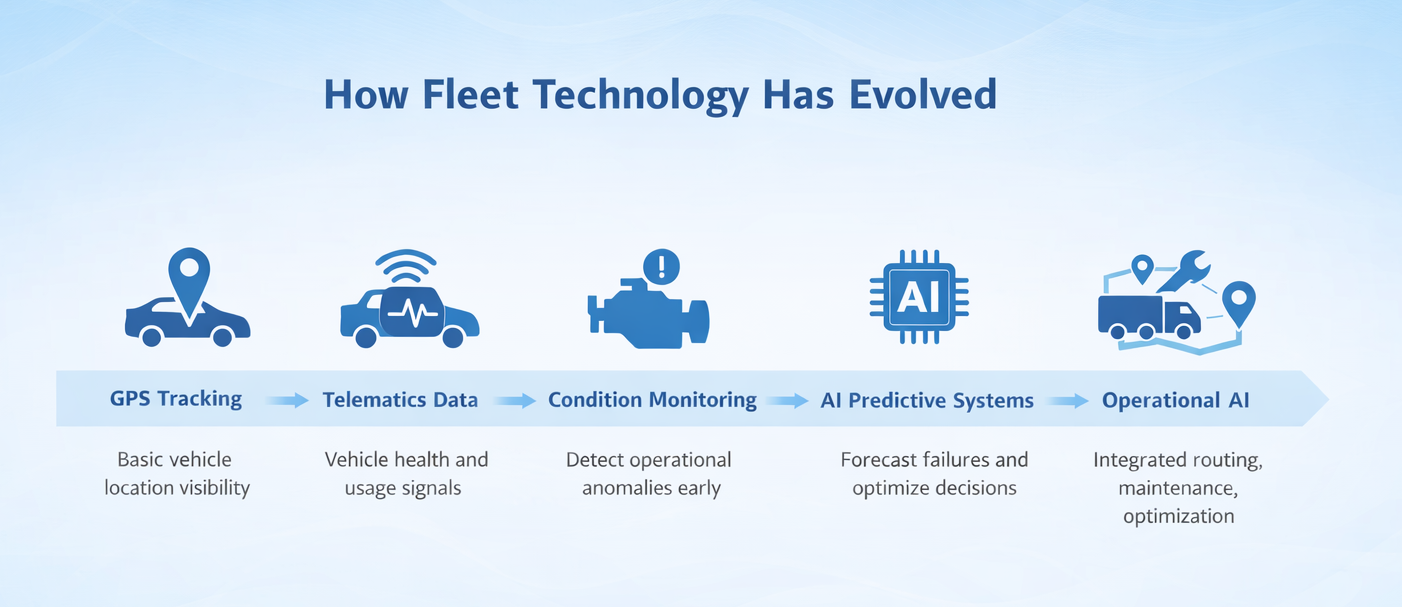
Let’s face it, media hypes up every new innovation. The news around AI is no different than it was about cloud computing or streaming content. Yet, we know that AI in terms of logistics is a logical evolution of technology that’s been in place for decades:
- GPS tracking has been used in logistics for years to improve route planning.
- Basic telemetry has been helping with preventive maintenance, among other things.
- Condition monitoring has been helping firms stay ahead of unplanned breakdowns.
- AI-driven predictive maintenance has now folded those functions into a faster communication system.
- Integrated route and maintenance optimization has led to faster delivery with less downtime.

Predictive Maintenance for Fleets
The most important metrics include:
- MTBF improvement – Increasing the Mean Time Between Failure metric translates to more time on the road, less time in the shop.
- Downtime reduction (25–50%) – This reduction translates into real cost savings, optimization of your fleet assets.
- Maintenance cost reduction (20–30%) – Everybody wants to reduce maintenance costs, including labor and parts.
Some of the ways that sensors and AI help you with those metrics include:
- Vibration anomaly detection – Monitors high-frequence oscillations in mechanical components, like wheel bearings, transmission gears or planetary gear sets, and drive shafts. Sensors capture data points that show vibrations outside a “normal” signature baseline. Catching problems before failure can avoid large reactive costs.
- Engine temperature prediction – Using regression models or Long Short-Term Memory (LSTM) networks, AI systems predict when the engine temperature will exceed a safe threshold. Advanced systems will alert a driver to pull over or adjust their driving style before the engine enters “limp mode” or suffers a blown head gasket.
- Failure classification models – Once a problem is detected, these models categorize the specific type of fault or determine which subsystem is failing. AI systems are trained with supervised learning algorithms to distinguish between different failure modes. These models move you beyond the dreaded “Check Engine” light to a specific diagnosis, for example, “90% probability of fuel injector clogging.”
Optimizing Routes Beyond Static Maps
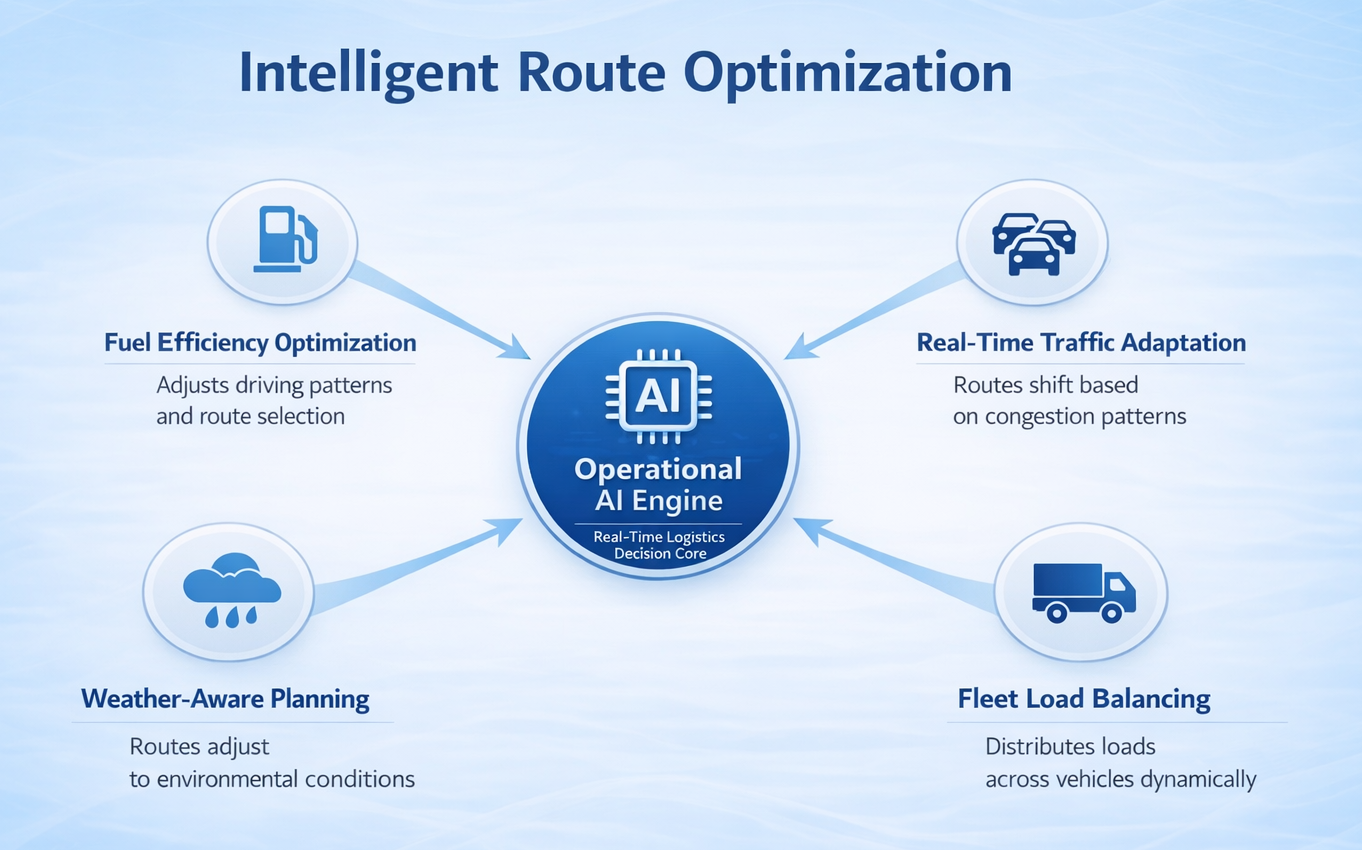
We’ve all gotten used to the way that mapping and traffic apps provide real-time updates on road and traffic conditions. These types of capabilities have continued to be expanded for fleet optimization. Some of the improvements include:
- Dynamic fuel optimization – You can reduce fuel expenses by 5%-10% by avoiding “fuel-heavy” maneuvers and routes. AI analyzes engine load, gear ratios, and aerodynamics along with external factors like road incline and weather conditions. The AI can recommend or even force optimal speed adjustments to keep the engine operating in its most efficient power band.
- Real-time traffic and load balancing – AI systems can monitor the location of a vehicle, the traffic that vehicle is running into, and what it’s carrying. When it becomes mathematically more efficient to reroute the vehicle to pickup an unplanned “backhaul” load, the system does that. This eliminates or reduces the problem of overloading on some vehicles while others go underutilized.
- Weather integration – Systems can integrate hyper-local weather forecasts which, when combined with route and vehicle data, allow routes to be adjusted based on external factors like wind, snow, ice, or other hazards. The system can adjust ETA, and can even trigger a maintenance alert. For example, if a truck is operating in difficult conditions like excessive heat or on salted roads.
- Risk modeling – This is a statistical ranking approach that looks at historical data about the route, the conditions, time of day, even crime statistics for the area. The system ranks the probability of certain problems or situations and can adjust delivery times, alert drivers, and reroute.

How Does All This Work?
As discussed earlier in this article, many of the foundational technologies that make this work have been in place, in some form or another, for years.
- Edge data collection in vehicles – The use of sensors and a variety of data collection algorithms that are now standard in many vehicles enables the collection of vehicle data, including weight, speed, locations, road conditions, and more.
- Cloud training – Large Language Models (LLMs) and more tailored industry models collect massive amounts of data every day. This data is typically non-identifiable as far as individual personal data. With enough vehicle, road condition, weather, and other data AI systems can find patterns and generalize for widespread use.
- Mobile deployment – The ubiquitous use of mobile phones, tablets, and special purpose devices has made it possible to deliver real-time advice and alerts to drivers and warehouses.
- Central command dashboards – Dashboards have always been useful as a snapshot of various systems. But now, dashboards serve as a central command center. This dashboard helps dispatchers monitor and adapt to changes, almost immediately.
Industry-Wide Measured Outcomes
According to McKinsey and to the World Economic Forum (WEF), the logistics industry has measured significant savings over the last few years, as AI systems become more widely available:
- 15–25% fuel savings
- 30–45% inventory reduction (where fleets link to supply chain)
- 10–20% asset lifespan increase
The Bottom Line
Operational AI for logistics is not a transportation initiative, it’s an enterprise operations strategy. Bridgera’s AI solutions can help you deploy an end-to-end system that improves business outcomes, not just fleet maintenance outcomes.
Frequently Asked Questions (FAQ)
1. What’s the difference between preventive and predictive maintenance for fleets?
Preventive maintenance follows scheduled intervals to reduce breakdowns, but predictive maintenance goes a step further by using AI, sensors, and real-time data to anticipate failures before they happen. Predictive systems continuously monitor components like wheel bearings, drive shafts, and engine temperature, flagging issues early. They don’t just alert you, they go beyond a generic “Check Engine” light to give you specific, probability-based diagnoses.
2. What kind of cost savings can we realistically expect from AI-driven fleet optimization?
According to documented outcomes, predictive maintenance alone can reduce downtime by 25-50% and cut maintenance costs by 20-30%. Route optimization can reduce fuel expenses by 5-10%. At the industry level, McKinsey and the World Economic Forum report 15-25% fuel savings, 30-45% inventory reduction for fleets tied to supply chains, and a 10-20% increase in asset lifespan.
3. How does AI improve route planning beyond what GPS and traffic apps already do?
Standard mapping apps provide real-time traffic updates, but AI fleet optimization can deliver more granular details. AI can factor in engine load, gear ratios, road incline, aerodynamics, hyper-local weather, and even historical crime statistics along a route. It can dynamically reroute vehicles to pick up unplanned backhaul loads, balance cargo across your fleet to reduce over- and underutilization, and proactively adjust ETAs.
4. What technologies are actually powering these AI capabilities?
The system builds on technology that’s been evolving for decades, such as GPS tracking, basic telemetry, and condition monitoring. What AI adds is a faster, more integrated intelligence layer on top. Edge sensors in vehicles collect real-time data on weight, speed, vibration, and temperature. That data feeds cloud-based models (including LLMs and industry-specific models) that identify patterns. Insights are then delivered through mobile devices to drivers and through central command dashboards to dispatchers, thus enabling near-real-time decision-making.
5. What specific failure types can AI actually detect and diagnose?
AI systems use several detection methods that work in concert. Vibration anomaly detection monitors oscillation signatures in components like transmission gears and wheel bearings. LSTM neural networks and regression models predict when engine temperature will breach safe thresholds, sometimes alerting drivers to adjust their driving before triggering “limp mode.” Failure classification models, trained through supervised learning, then categorize the specific fault, for example, flagging a 90% probability of fuel injector clogging rather than expecting a technician to guess.
6. Is AI fleet optimization only relevant for large enterprise fleets?
No, the document frames operational AI as an enterprise operations strategy not just a transportation initiative for large carriers. Because the foundational technologies (telematics, mobile devices, cloud platforms) are already widely available, mid-sized logistics firms can access these capabilities too. The business case applies at any scale: reducing reactive maintenance, improving vehicle availability, and improving customer satisfaction all have compounding financial benefits regardless of fleet size.
About Bridgera
Operational Intelligence. Production-Ready AI.
Bridgera partners with operations-heavy enterprises to move AI beyond pilots and into real production systems. Through AI consulting, specialized talent, and scalable platforms like Interscope AI™, Bridgera embeds intelligence directly into the operational workflows that power the business.